
Beginner Driver Education · Rules of the Road
Understanding the Demerit Point System in Canada
Driviology Road Safety Education Team
What this actually means for you
Rules like this are not trivia for the written test. They decide what you do in the two or three seconds when there is no time to think. The system adds points to a licence if a driver breaks specific road laws and is convicted. On the road test, this is scored every single time it comes up — not once, but as a pattern across the whole drive.
Demerit Points System - Rules of the Road in Canada
Canada employs a unique system to monitor drivers—the Demerit Points System. The system adds points to a licence if a driver breaks specific road laws and is convicted. If the driver collects a threshold of points, the Ministry of Transportation may revoke their licence.
How the demerit point system works
All drivers start with zero points. Every time a driver breaks road rules and is convicted, the driver accumulates demerit points. The number of Demerit points varies based on the violation. Demerit points stay on the driver’s driving record for two years, starting the day of the initial offence report. If the driver gathers enough points, it could lead to a revoked licence.
The demerit point system applies in all Canadian provinces and territories.
How demerit points are applied
Various offences result in a range of points added to the driver's licence. The table below shows the demerit points for different violations.
| Points | Offence |
|---|---|
| 2 Points |
|
| 3 Points |
|
| 4 Points |
|
| 5 Points |
|
| 6 points |
|
| 7 points |
|
Consequences and Penalties
The consequences vary depending on whether the individual is a novice driver or one with a full licence. They also depend on the number of individual licence demerit points.
Consequences for a driver with a full licence;

What happens at each level of Demerit Points
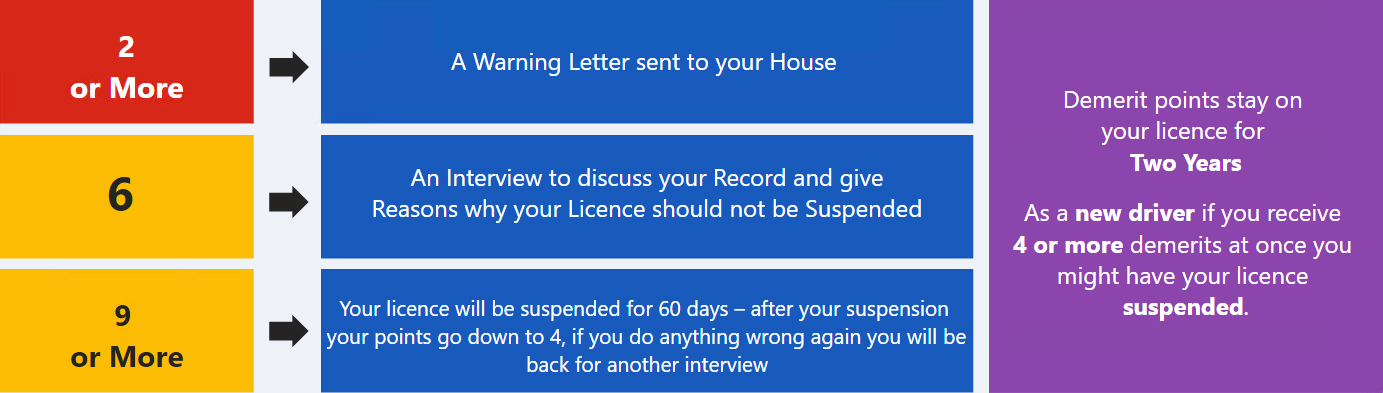
Source: https://www.ontario.ca/page/understanding-demerit-points
Obey the Police
It is essential always to follow the instructions of a law enforcement officer.
When being pulled over by a police officer, the driver must come to a stop on the right-hand side of the road as soon and as safely as possible. The driver must remain seated in the car; do not step out. Wait for the officer to walk up to the vehicle and be sure to comply with their instructions. Failure to comply can lead to car impounding, licence suspension, or both.
Using this on Ontario roads — and on your road test
Ontario's rules are enforced as written, and 'everyone does it' is not a defence — rolling stops, creeping into crosswalks, and casual lane changes are everyday sights in Toronto traffic and everyday reasons people collect tickets and demerit points. The standard that keeps you safe is the same one examiners mark to: full stops, correct lanes chosen early, and signals that actually communicate something to the drivers around you. Drive to the rule, not to the traffic around you.
Questions drivers ask us
Can you explain demerit point system in Canada in simple terms?
Every time a driver breaks road rules and is convicted, the driver accumulates demerit points.
What should new drivers know about consequences and penalties?
The consequences vary depending on whether the individual is a novice driver or one with a full licence.
Do I need to know this for the G1 written test too?
Yes — this is core G1 knowledge, and it is tested again in real life on the G2 and G road tests. The written test checks that you know the rule; the road test checks that you actually do it when nobody is prompting you.
What should new drivers know about obeying the police?
It is essential always to follow the instructions of a law enforcement officer.