
Beginner Driver Education · Rules of the Road
Understanding Traffic Signals: A Guide for Drivers and Pedestrians
Driviology Road Safety Education Team
What this actually means for you
This is the kind of rule that is easy to nod at in a classroom and then get wrong at a real intersection, so it pays to understand what it actually requires of you. Traffic lights are control devices that instruct and control drivers and pedestrians. On the road test, this is scored every single time it comes up — not once, but as a pattern across the whole drive.
Traffic Signals Explained: A Complete Guide for Road Users
Traffic lights are control devices that instruct and control drivers and pedestrians. They ensure uniformity and significantly reduce chaos. Different colours and strobes have different meanings.
A motorist must always signal before they change their course:
- Moving off
- Turning right or left, changing lanes
- Overtaking
- Slowing down
- Stopping
Please note that Signals indicate intent, not confer a right of way.
Suppose the driver is concerned that their direction indicators are not working. In that case, the lamps are not giving an adequate signal, and the driver uses clear, decisive hand signals.
Before manoeuvre, one must exercise care and attention to other road-users, road conditions and how driving will impact other road-users.
Always take care, especially when intending to change lanes;
- Turn across oncoming traffic
- Drive onto or exit from a roundabout
Drive into or reverse into a parking space.

Did you Know?
The standard signal sequence is "GYRG," i.e.
Green - Yellow - Red - Green
Do you know why?
The standard signal sequence aims to assist drivers who may be colour-blind or unable to see the signal.
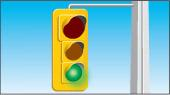
Green lights indicate that you can go in any direction. Before proceeding, be sure to look and yield to other road-users.
2. Yellow Light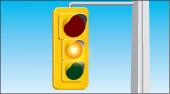
A yellow light indicated that the signal was about to turn red. Stop if you can; otherwise, proceed carefully.
3. Red Light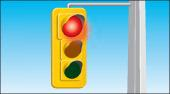
Drivers must stop at a red light. Stop the vehicle at the stop mark line.
Wait for the light to turn green, and proceed cautiously.
4. Simultaneous Left Turn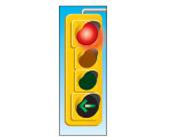
If both a red and a left-turn green light show simultaneously, you can turn left after yielding to other vehicles on that route. Be sure that you are in the correct lane when turning.
Transit Priority Signals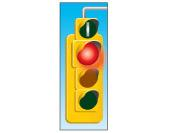
These appear as a vertical white-coloured bar against a dark background.
This signal is red for all vehicles apart from transit vehicles, and all other vehicles must yield for transit vehicles.
5. Flashing Red Light
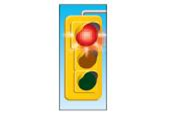
When you see this light, come to a complete stop. Observe the intersection; only if it is clear may you proceed through it.
Flashing Yellow Light
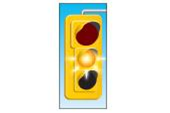
Flashing yellow lights means driving cautiously when approaching and moving through an intersection.
6. Flashing Red Beacon

This sign warns you to drive slowly and cautiously.
7. Flashing Yellow Beacon

A flashing yellow beacon above an intersection, a warning sign, or an obstruction in the road warns drivers to drive cautiously.
Pedestrian Signals
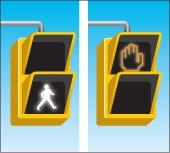
If pedestrians see a flashing or steady hand symbol, they should not cross the road. Pedestrians should only cross the road when the white pedestrian appears on the signal. If the countdown timer is present, it indicates the time remaining for pedestrians to cross the street. Most countdown timers emit audible beeps to assist sight-impaired pedestrians.
Using this on Ontario roads — and on your road test
Ontario's rules are enforced as written, and 'everyone does it' is not a defence — rolling stops, creeping into crosswalks, and casual lane changes are everyday sights in Toronto traffic and everyday reasons people collect tickets and demerit points. The standard that keeps you safe is the same one examiners mark to: full stops, correct lanes chosen early, and signals that actually communicate something to the drivers around you. Drive to the rule, not to the traffic around you.
Questions drivers ask us
Can you explain traffic signals in simple terms?
In that case, the lamps are not giving an adequate signal, and the driver uses clear, decisive hand signals.
What happens if I get this wrong on the road?
It depends on the rule, but traffic offences in Ontario can bring a fine and demerit points, and they stay on your driving record. For new drivers the stakes are higher — repeat or serious offences can lead to a licence suspension, on top of what they do to your insurance.
Do I need to know this for the G1 written test too?
Yes — this is core G1 knowledge, and it is tested again in real life on the G2 and G road tests. The written test checks that you know the rule; the road test checks that you actually do it when nobody is prompting you.