
Beginner Driver Education · Vehicle Handling
Essential Parking Tips and Techniques for Safe Vehicle Handling
Driviology Road Safety Education Team
What this actually means for you
This is car control at its most basic, and it is worth understanding properly instead of just copying what an instructor tells you. Perpendicular parking involves positioning your vehicle at a 90-degree angle to the curb or parking lines, commonly found in parking lots. It is also one of the things examiners feel in the first minute: smooth, deliberate car control reads as a safe driver before anything difficult has even happened.
Parking Techniques and Safety Tips | Vehicle Handling
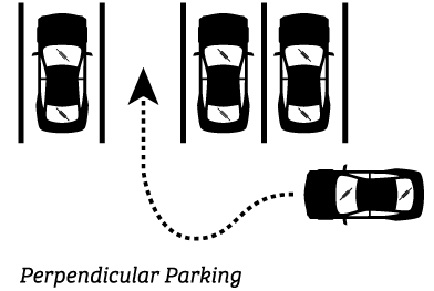
Perpendicular Parking:
Perpendicular parking involves positioning your vehicle at a 90-degree angle to the curb or parking lines, commonly found in parking lots. To execute perpendicular parking effectively, follow these expanded steps:
Approach the Parking Space:
- Identify the Space: Select an available parking space and ensure it is clear of obstacles or hazards.
- Signal Your Intent: Activate your turn signal to indicate your intention to park. This alerts other drivers of your planned maneuver.
Position Your Vehicle:
- Align Properly: Drive parallel to the parking space at a distance that allows room to maneuver. Typically, this distance should be around one and a half to two car widths from the space.
- Slow Down: Reduce your speed as you approach the parking space to maintain better control over the vehicle.
Turn Outwards:
- Initial Turn: Begin by turning the steering wheel outwards, away from the parking space. This initial outward turn creates a wider angle for the entry maneuver.
- Create Room: By turning outwards, you create sufficient space to turn into the parking space without clipping adjacent vehicles or crossing into other spaces.
Turn Into the Space:
- Sharp Turn: As you pass the parking space, sharply turn the steering wheel in the opposite direction, aiming to direct the front of your vehicle into the center of the parking space.
- Check Mirrors and Blind Spots: Before turning, ensure no pedestrians, cyclists, or other vehicles are in your path.
Align and Straighten:
- Adjust Steering: Once your vehicle is inside the parking space, straighten the steering wheel to align it within the lines.
- Center the Vehicle: Make minor adjustments to ensure your vehicle is centred in the space and not encroaching on adjacent spaces.
Finalize the Parking:
- Stop the Vehicle: Bring your vehicle to a complete stop once it is entirely within the parking lines.
- Engage Handbrake: Apply the handbrake (parking brake) to secure the vehicle.
- Turn Off the Engine: Switch off and remove the key from the ignition.
- Lock the Doors: Ensure all doors and windows are closed before leaving the vehicle.
Additional Tips for Perpendicular Parking:
- Practice Precision: To improve accuracy and confidence, practice perpendicular parking in an empty lot.
- Observe Surroundings: Always be mindful of pedestrians and other vehicles when maneuvering into or out of a parking space.
- Use Gadgets: If your vehicle is equipped with a backup camera or parking sensors, use them to assist in aligning your vehicle correctly.
- Adjust as Needed: If your vehicle is not centred, do not hesitate to adjust by reversing slightly and re-aligning.
- Stay Within Lines: Ensure your vehicle is entirely within the parking space lines to avoid blocking adjacent spaces and maintain orderly parking.
Following these detailed steps and tips, you can perform perpendicular parking safely and efficiently, ensuring that your vehicle fits neatly into the space and minimizing the risk of collisions or obstructions.
Using this on Ontario roads — and on your road test
In the GTA you will use this in tight plaza parking lots, steep underground garage ramps, and stop-and-go traffic on roads like Kennedy or Eglinton where space is always being negotiated. Break the skill into small pieces and master each one at low speed, because low speed is where examiners watch it most closely too — most handling marks on a road test are won or lost below 30 km/h, in parking lots and quiet side streets, long before the highway portion starts.
Questions drivers ask us
Can you explain essential parking tips and techniques for safe vehicle handling in simple terms?
Following these detailed steps and tips, you can perform perpendicular parking safely and efficiently, ensuring that your vehicle fits neatly into the space and minimizing the risk of collisions or obstructions.
How should I practise this as a new driver?
Start at low speed, in a quiet area, with your instructor or supervising driver beside you. Build the movement step by step until it feels routine, then use it in normal traffic. Rushing a new technique at full speed is how small errors turn into bad habits.
Will this come up on my G2 or G road test?
Very likely, yes. Handling is scored throughout the test — steering smoothness, speed control, braking, and how you position the car. Examiners are not looking for perfection; they are looking for calm, planned control, and for mistakes to be small and corrected early.